Asahikawa旭川 · Hokkaido river town日本語

About Asahikawa · 旭川について

Asahikawa in five minutes5分でわかる旭川

Asahikawa is Hokkaido’s second city and calls itself the base city of the north. It sits in the Kamikawa Basin, Hokkaido’s largest, where the Ishikari, Ushishubetsu, Chūbetsu and Biei rivers meet. It grew from Meiji farmer-soldier villages and an army town, and 309,393 people lived here on 1 September 2026.⁠[2][4][63][1][58]

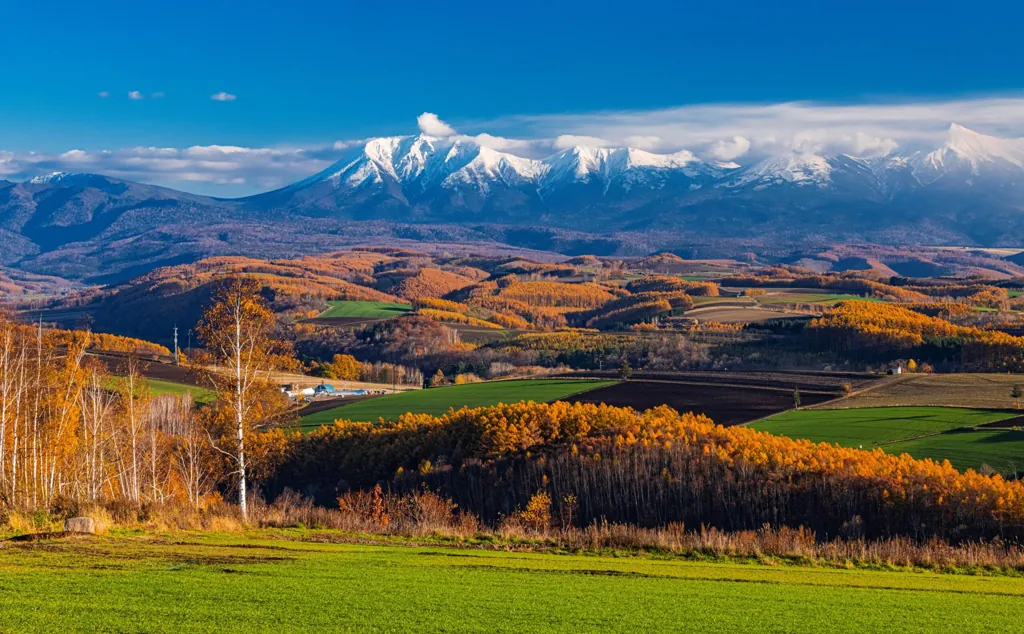
Autumn fields roll toward snow-capped mountains from Shūjitsu Hill, Asahikawa
© HOKKAIDO LOVE!

Grab a warm drink. Here’s my town in five minutes.5分でまちを紹介!

The name

Chiw-pet: where the name comes from 名前の由来

  1. Chiw petチゥ ペッthe river’s Ainu name
  2. Chūbetsu忠別the old place name
  3. Asahikawa旭川the village of 1890
From a river’s name to the city’s name⁠[13][4]

Chiw-pet and the old name Chūbetsuチゥ ペッと旧称「忠別」

Before 1890 the area was called Chūbetsu, after the Ainu name of the Chūbetsu River. The city museum’s first Ainu place-name sign (2003) writes the river’s name as Chiw pet; a later sign at the Kitasaito Garden (2018) uses Chuk pet. The Kawamura Kaneto Ainu Memorial Museum still gives its address in Ainu as Yaunmosir Chiwpet-kotan.⁠[13][14]

The Meiji “sun river” reading明治の「太陽の川」説

In February 1890, seven months before the villages were created, the Hokkaido Mainichi Shimbun printed comments by Okabe (岡部方幾), a sergeant at the farmer-soldier headquarters. He said that in Ainu pronunciation Chūbetsu was Chuppet, with chup meaning “sun” or “east” and pet meaning “river”, so a name such as 旭川, “rising-sun river”, would keep the old meaning while also honoring the Empire. The place-name scholar Nagata Hōsei gave almost the same reading in his 1891 dictionary of Hokkaido’s Ainu place names.⁠[4]

What later scholars saidのちの研究者の見方

Later scholars said the chup-pet reading of the river’s name was wrong. Chiri Mashiho read it as chiw-pet, “wave (swift-current) river”, and Yamada Hidezō proposed chuk-pet, “autumn river”.⁠[4]

Kawa or gawa?「かわ」か「がわ」か

The city has basically read its name Asahi-kawa, although the 1890 official gazette that announced the new village printed Asahi-gawa. Asahikawa Station and the central post office used Asahi-gawa until JR Hokkaido changed the station reading in March 1988; post offices and other facilities then followed.⁠[4]

Ainu names around the city市内のアイヌ語地名

Chikabumi (Chikap-ni), Kamuikotan (Kamuy-kotan), the Ushishubetsu River (ウシㇱ ペッ) and Arashiyama (Chi-nomi-sir) all have Ainu names. Since FY2003 the city has put up bilingual Ainu–Japanese signs, 42 of them by December 2025. The city translates Kamuikotan as “village of the gods”.⁠[13][15]

History

A short history in 25 moments あゆみ

Some of these moments come from Ainu oral history, as the Kawamura Kaneto Ainu Memorial Museum tells it.⁠[62]

  1. Jōmon period

    Finds show early settlement. The Kamuikotan pit-dwelling site is a Hokkaido-designated historic site.⁠[4]

    Kamuikotan
  2. Mid-Edo period

    The Kamikawa Ainu live and fish along the upper Ishikari, and Japanese traders deal with them near where the Chūbetsu and Biei rivers join the Ishikari.⁠[4][16]

  3. Late Edo period

    Matsuda Ichitarō and Matsuura Takeshirō are among the first Japanese to explore the Daisetsuzan range.⁠[4]

  4. Late Edo or early Meiji

    Ainu oral history, as told by the Kawamura museum, remembers the Kamikawa chief Kuchinkure. When officials tried to move his people down to Ishikari, he argued the land had been given to them by the gods, not by the Japanese government, and the order was dropped.⁠[62]

    Chinomishir Kamuynomi
  5. 1877

    The first Japanese settler, Suzuki Kamezō, arrives at today’s Kamekichi.⁠[4]

  6. 1885

    Iwamura Michitoshi and Nagayama Takeshirō survey the basin from Chikabumi-yama. A monument to that view now stands in Arashiyama Park.⁠[1][4]

    Arashiyama Lookout & Hoppō Yasōen
  7. 1890

    On 20 September, Hokkaido creates three villages here: Asahikawa, Kamui and Nagayama.⁠[4][1]

  8. 1891

    400 farmer-soldier (tondenhei) households settle at West and East Nagayama. The same year, the Ainu living around Asahikawa are moved to Chikabumi.⁠[63][16]

    Nagayama
  9. 1892

    Another 400 farmer-soldier households settle in Asahikawa Village, today’s Higashi-Asahikawa district.⁠[63][1]

    Higashi-Asahikawa
  10. 1898

    The Kamikawa Line from Takikawa reaches Asahikawa, and the population then grows by about 1,000 a year.⁠[1][4]

  11. 1901

    The Imperial Army’s 7th Division moves its headquarters here from Sapporo, next to the Chikabumi Ainu land. The Ainu protest to the Hokkaido government and in Tokyo and are allowed to stay, but are left with free use of only one-fifth of their land.⁠[1][16]

  12. 1902

    On 25 January the thermometer reads −41.0 °C, still the lowest ever recorded at a Japan Meteorological Agency observatory.⁠[10]

  13. 1916

    The Kawamura Kaneto Ainu Memorial Museum opens. It calls itself Japan’s oldest Ainu museum.⁠[37]

    Kawamura Kaneto Ainu Memorial Museum
  14. 1922

    Asahikawa becomes a city on 1 August. The same year, the young Ainu writer Chiri Yukie, who had lived in Asahikawa, writes the preface to Ainu Shin’yōshū, her collection of Ainu sacred songs; it is dated 1 March. She died at 19.⁠[1][37]

    The Day the Silver Drops Fall
  15. 1932

    The present Asahibashi Bridge and the Sekihoku Line to the Okhotsk coast are completed.⁠[1]

    Asahibashi Bridge
  16. 1945

    US carrier aircraft bomb Asahikawa in July. After the war, Shidan-dōri (“Division Street”) is renamed Heiwa-dōri (“Peace Street”).⁠[61][4][1]

  17. 1955–1971

    Mergers with six neighboring towns and villages make the city more than 17 times larger.⁠[3][4][1]

    Districts
  18. 1960

    The first Winter Festival is held.⁠[1]

    Asahikawa Winter Festival
  19. 1966

    Asahikawa Airport opens.⁠[1]

    Flying in
  20. 1967

    Asahiyama Zoo opens, Japan’s northernmost zoo.⁠[2]

    Asahiyama Zoo
  21. 1972

    Heiwa-dōri Kaimono Kōen opens as Japan’s first permanent pedestrian shopping street.⁠[2]

    Heiwa-dōri Kaimono Kōen
  22. 2004

    In July and August, Asahiyama Zoo draws more visitors than any other zoo in Japan.⁠[1]

  23. 2019

    UNESCO names Asahikawa a Creative City of Design.⁠[1]

    Furniture & design
  24. 2025

    The city hosts the 28th National Confectionery Exposition, with 261,336 visits over 17 days.⁠[65]

  25. 2026

    In April the city begins charging an accommodation tax.⁠[17]

    Accommodation tax
Climate

How cold, how snowy? 気候

Below zero all day on about 74 days a year. Perfect for me!⁠[21]ペンギンにはちょうどいい!

Average year 平年の値

  • 7.2 °CMean annual temperature⁠[21][22]
  • −7.0 °CJanuary average⁠[21][22]
  • −11.7 °CJanuary average low⁠[22]
  • 21.2 °CAugust average⁠[21][22]
  • 1,104.4 mmPrecipitation a year⁠[22][21]
  • 557 cmSnowfall a season⁠[22][21]
  • 151.5 daysDays with snow⁠[22][21]
  • 89 cmDeepest snow on the ground, average⁠[22][21]
  • 73.7 days a yearDays below 0 °C all day⁠[21]
  • 10.9 days a yearDays reaching 30 °C⁠[21]

Averages are 1991–2020 normals at the Asahikawa observatory.⁠[21][22]

The record book 記録

  • Record low−41.0 °C, 25 January 1902⁠[10]
  • Record high37.9 °C, 7 August 2021⁠[10]
  • Deepest snow cover138 cm, 4 March 1987⁠[10]
  • Snowiest season944 cm, winter 1965–66⁠[10]
  • Warmest year2025, averaging 9.0 °C⁠[10]
  • Etanbetsu station low−38.1 °C, 17 February 1978⁠[66]
City symbols

The city’s tree, flower, bird and more 市のシンボル

  • Tree · Adopted 1976

    Japanese rowanナナカマド

    ⁠[59]
  • Flower · Adopted 1976

    Azaleaツツジ

    ⁠[59]
  • Bird · Adopted 1978

    Bohemian waxwingキレンジャク

    ⁠[59]
  • Insect · Adopted 1978

    Kantan tree cricketカンタン

    ⁠[59]
  • Emblem · Adopted 1911

    Star and red sun北斗星と赤い太陽

    Adopted on 29 June 1911. The star outline stands for Hokkaido, and the red sun at the center for Asahikawa as Hokkaido’s central city.⁠[59]

  • Mascot

    Asappyあさっぴー

    A harbor-seal boy who turned himself into a polar bear, the animal he admired. His T-shirt shows the Daisetsuzan range, his belt is Asahibashi Bridge, his striped pants are the rivers, and his fringe is ramen noodles. He turned 15 in 2026.⁠[60][5]

Sister cities

Sister and friendship cities 姉妹都市

  • USASister cities

    Bloomington & Normal, Illinoisブルーミントン市・ノーマル市(イリノイ州)

    Since: Bloomington 11 October 1962; Normal joined in 1987⁠[81][1]

  • RussiaFriendship city

    Yuzhno-Sakhalinskユジノサハリンスク市

    Since: 10 November 1967⁠[81]

  • South KoreaSister city

    Suwon, Gyeonggi Province水原市(京畿道)

    Since: 17 October 1989⁠[81]

  • ChinaFriendship city

    Harbin, Heilongjiang Province哈爾濱市(黒龍江省)

    Since: 21 November 1995⁠[81]

  • JapanDomestic sister city, also a disaster-support partner

    Minamisatsuma, Kagoshima Prefecture南さつま市(鹿児島県)

    Since: 3 May 2015⁠[81]

  • JapanDisaster-support agreement

    Kitanagoya, Aichi Prefecture北名古屋市(愛知県)

    ⁠[81]

People

People linked to Asahikawa ゆかりの人

  • Inoue Yasushi井上靖

    Novelist (The Blue Wolf, Hyōheki), born in Asahikawa. The Inoue Yasushi Memorial Hall opened here in 1993.⁠[4][1]

  • Miura Ayako三浦綾子

    Novelist (Hyōten, Shiokari Pass), honored by a citizen-run literature museum in the Sample Forest.⁠[4][46]

  • Victor Starffinヴィクトル・スタルヒン

    The first pitcher in Japanese professional baseball to win 300 games. The city’s Hanasaki baseball stadium is nicknamed “Starffin Stadium”.⁠[4]

  • Tamaki Kōji玉置浩二

    Singer of the rock band Anzen Chitai.⁠[4]

  • Kitaguchi Haruka北口榛花

    Javelin thrower and Paris 2024 Olympic gold medalist; she received Asahikawa’s Citizens’ Honor Award.⁠[4]

  • Machida Rui町田瑠唯

    Basketball player who played in the WNBA; she also received Asahikawa’s Citizens’ Honor Award.⁠[4]